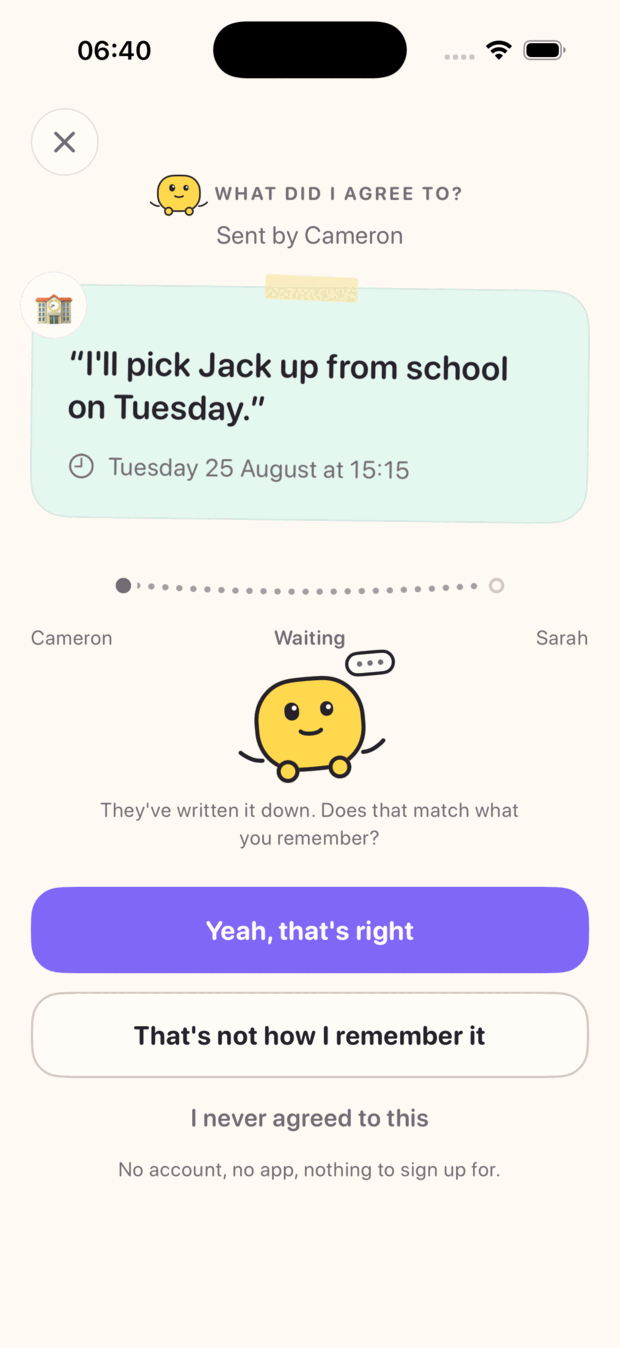
The person you send an agreement to never installs the app, never makes an account and never pays. Both halves work from the first minute.
The problem
Two people leave the same conversation remembering it differently. Not because anyone is dishonest. It is simply what memory does, and it does it to both of you at once.
A task says buy milk. An agreement says Sarah and I agreed I would buy the milk by six. Only one of those settles anything, and it is the one nobody writes down.
How it works
However you would say it out loud is fine.
They tap it and answer in seconds.
Yes, that is right. Or: that is not how I remember it, and here is how I do.
Who it is for
Splitting the chores without relitigating who said they would do the bins.
How couples use it
The shared household commitments that quietly become one person’s job.
How flatmates use it
Who is doing the school run, and which day it was actually agreed for.
How co-parents use it
Your sister said she would bring the dessert. Your brother borrowed the drill.
How friends use it
When you disagree
Most apps assume everyone agrees. This one assumes the opposite, because that is the moment it exists for.
They write their version instead, both stay on the record, and you decide which one stands. Nothing is quietly overwritten.
“I’ll drive if you book the hotel”
A nudge the day before, a few hours before, and when it falls due. Then one asking whether it actually happened. Nothing is ever marked done on your behalf.
For the ones where you both want to put your name to it. Off by default, because most agreements are about the bins. How signing works
Only the two people in an agreement can read it. No advertising networks, no analytics services, no third-party trackers in the app. Our privacy promise
What it costs
The person you send an agreement to never pays, never signs up and never installs anything. That part is free forever, for both of you.